
A donation of 434 black and white negatives was received by the library in 1983 from Mr A. E. Smith, Deputy Librarian of the National Library of New Zealand and a keen tram and train enthusiast.
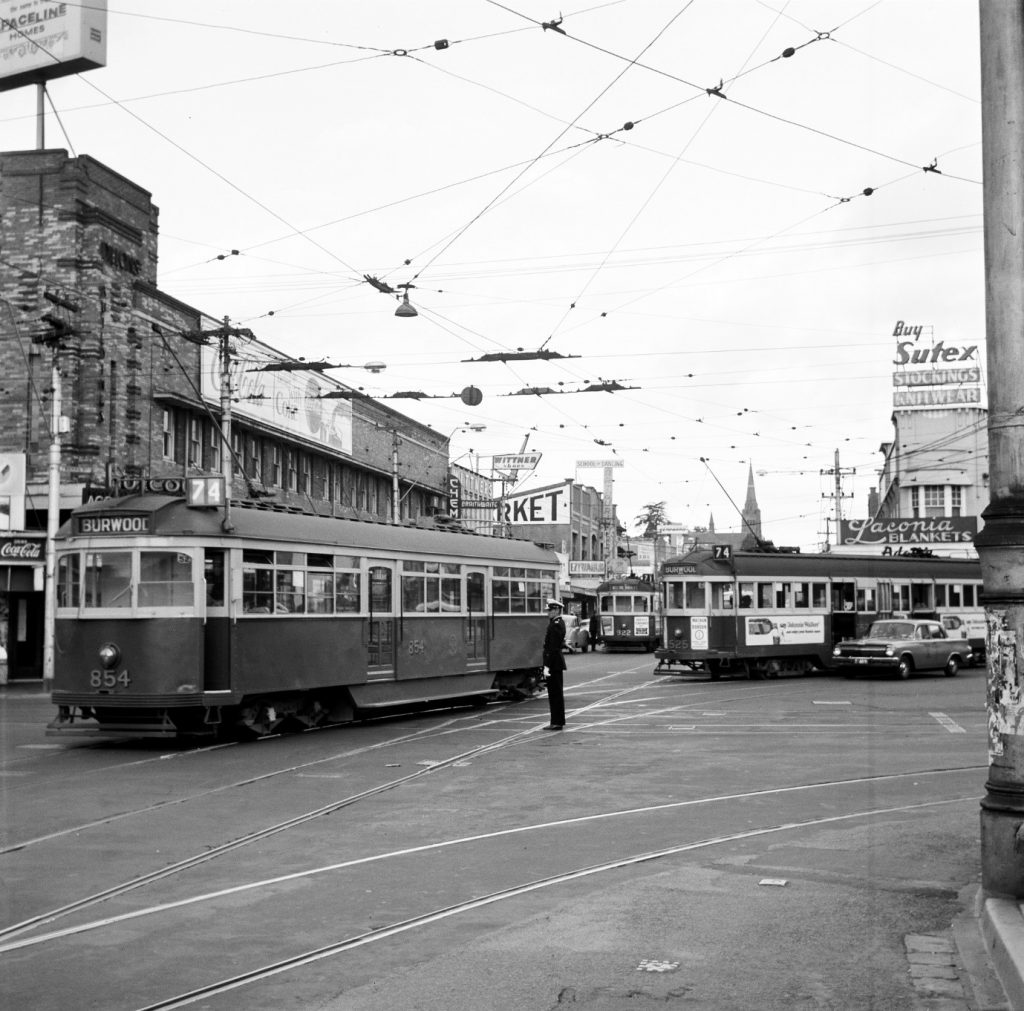
Smith visited Victoria between December 1966 and February 1967 to join tours organised by the Association of Railway Enthusiasts and the Australian Railway Historical Society. He travelled with these enthusiast groups through Melbourne and some suburbs, as well as regional Victoria, taking photographs of trams and trains.
Along with the images, Mr Smith provided notes about the date and location of each photograph and some information about the models of trams and trains. These were a great help when Library staff went about cataloguing the collection.
Scanning negatives
The sequence of negatives began with images of the city streets and an impressive shot of Flinders Street Station.
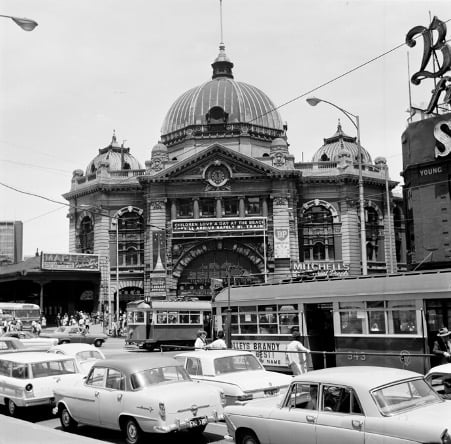
With the help of our photographers, the negatives were scanned to reveal beautiful black and white images of trams and trains travelling on suburban and regional routes in Victoria during the mid-1960s.
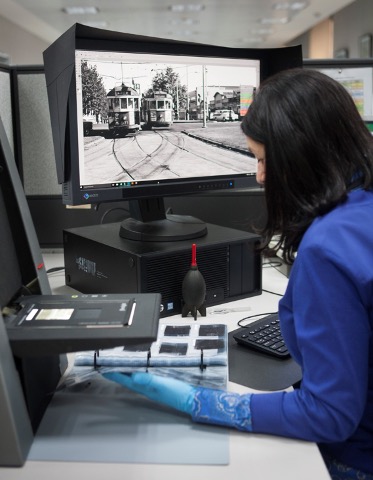
The negatives were received as separate squares rather than in strips. The negatives were individually housed in archival plastic pockets and labelled with unique accession numbers by the Preservation team.
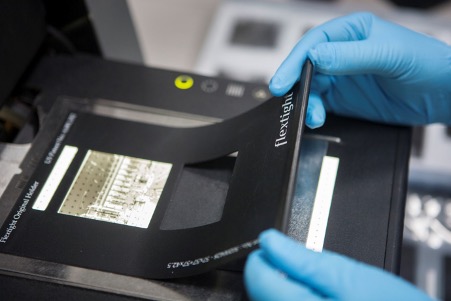
Each negative was individually scanned with the ‘Flextight’ scanner which has a specific holder to scan negatives.
The scanned image is adjusted for maximum detail in highlights and shadows using the scanning software to produce the best possible photographic reproduction of the original negative. The final scan is then saved as a high-resolution file (TIFF) ready for linking to the catalogue record as shown in the example below.
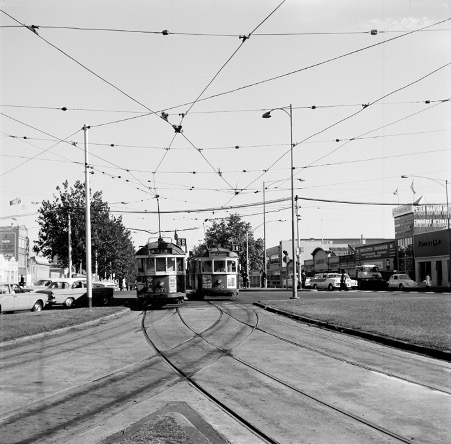
Cataloguing images
The high-resolution scans enabled detailed viewing of each image to assist with the identification of tram and train models, street names, building names and churches. A total of 158 catalogue records were created to cover the 434 images. Catalogue records included creator, title, date, description, research information, copyright status and subject headings.
In viewing the collection, it was obvious that the images captured many different classes and models of trams and trains, including:
- ‘W-class’ trams travelling through the city and suburb
- special ‘scrubber’ maintenance trams used to clean the tram lines
- second-hand trams running on the Ballarat and Bendigo lines
- old ‘red rattler’ Tait trains with separate ‘Smoking and ‘Non-Smoking’ compartments
- upgraded blue ‘Harris’ trains travelling on suburban lines
- steam and electric locomotives
- parcel and freight trains
- ‘Walker’ diesel railmotors used for longer train journeys
- ‘Puffing Billy’ steam locomotives and various passenger carriages
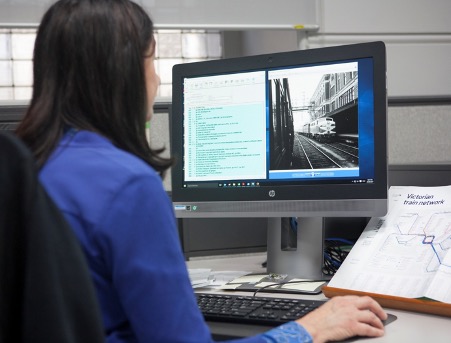
It was important to add this information to the catalogue records for quick and easy identification when searching. In addition to the notes and dates supplied by the donor, considerable detective work was required to identify and confirm the specific classes of trams and trains shown. Staff referred to many websites including the Melbourne Tram Museum, Bendigo Tramways, Ballarat Tramway Museum and Victorian Railways for past train models and years of operation.
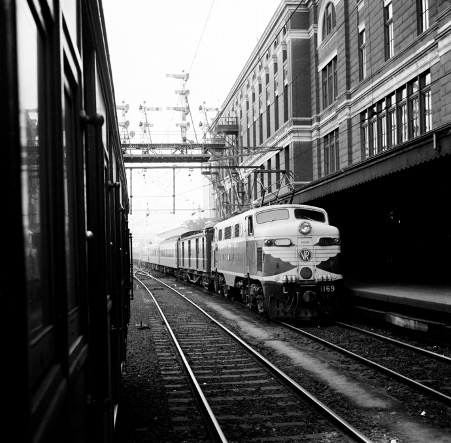
Staff used street view on Google Maps to track and identify tram and train routes, specific locations and the location of significant buildings seen in the background.
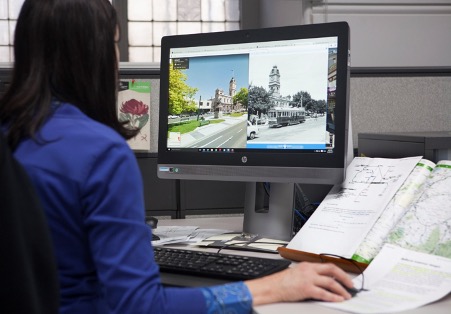
By matching the same ‘Street View’ orientation of the tram/train in the image, it was possible to identify the location, prominent buildings and street names as shown below.
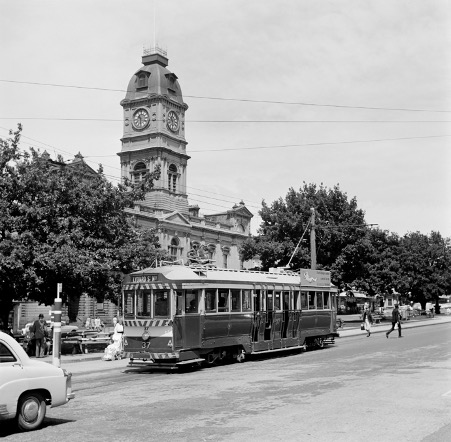
To utilise the full potential of the images for other types of reference/research work, specific information was also recorded for streets and intersections, railway stations, churches, cemeteries, heritage buildings, vintage adverting signs and even early model cars – not just trams and trains!
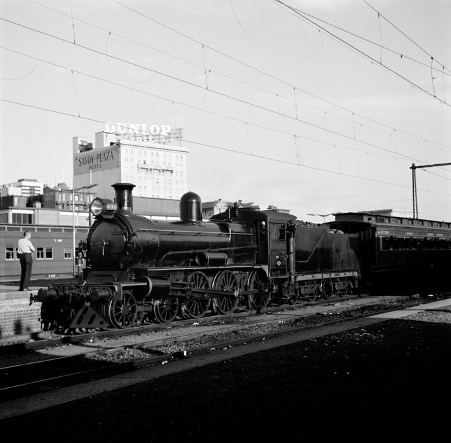
This was an enjoyable collection to work on as the images not only portrayed the different classes of trams and trains travelling through Melbourne and country Victoria, but also captured a time when life was simpler.
What was seen behind and around the trams and trains was equally interesting and revealing. Old buildings no longer standing, the tram stop at the corner milk bar, neon advertising signs in Camberwell and St Kilda, policeman directing traffic at intersections such as Flinders and Swanston streets and Camberwell Junction and kids hanging out the sides of the ‘Puffing Billy’ railway carriages.
You can view the complete collection of Smith’s trams and trains online.
Written by Liz Balogh, former Image Access Library Technician, Collection Digitisation.


A great collection, with much documentation of streetscapes and architecture as a bonus.
Congratulations, magnificent work.
Absolutely wonderful Love it
Great to see means of Transport from yesteryear.
I lived in Carrum,the mode of transport was shown here,great stuff.
Magnificant collection and great to see some of the excellent activities undertaken by that stand out organisation Association of Railway Enthusiasts.
Kia ora especially to Liz Balogh, to responders above and to the SLofV – great to see that this collection has had such wonderful professional attention. As a 21-yr old, I went to Melbourne – one of the near-legendary “overseas big smokes” then – in late 1966 for a few months before starting my post-grad Library Diploma in Wellington 1967. I got a temp job on the cleaning crew at Austin Hospital, Heidelberg and enjoyed being in and around Melbourne, trying to capture the “atmosphere” with my 120mm b&w camera. I’m now retired, a happy grandad and involved with a project digitising the analogue photo archive of http://www.railsoc.org.nz ; and enjoyed working with local history collections through my career. It was great being there in Oz and taking those photos; really pleased that the SLofV can use them in this way to carry evidence of earlier Melbourne times through to today and, more importantly, beyond at a respected and valued public agency. Ka pai!